
Boost Rider: Car Racing Games
EstotyRacing
4.4344.00 Reviews
- Version
- 1.0.19
- Installs
- 1.00M
- Age Rating
- Everyone
Screenshots
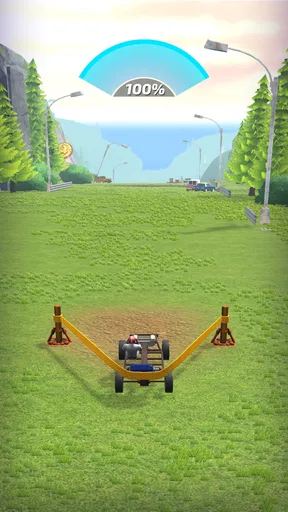
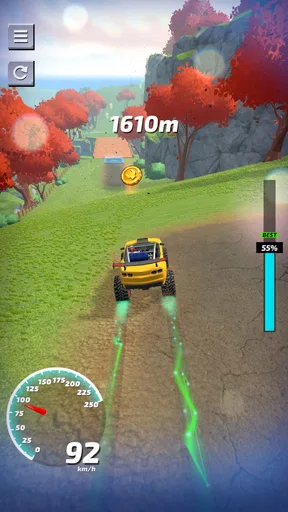
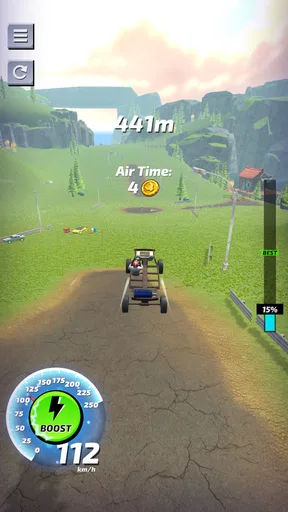
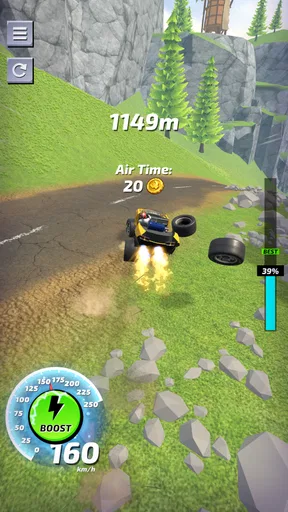
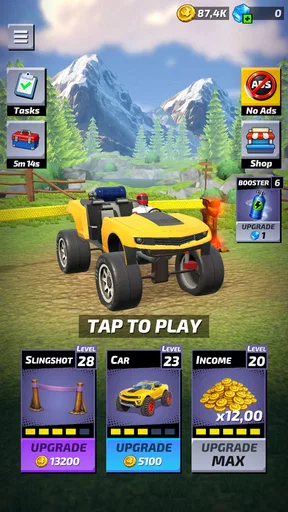
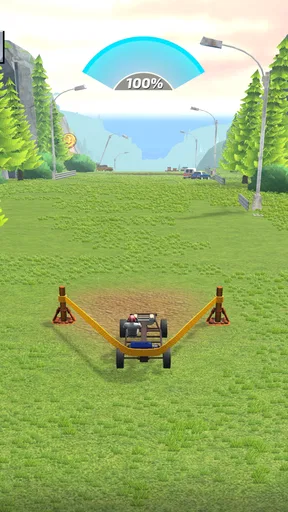
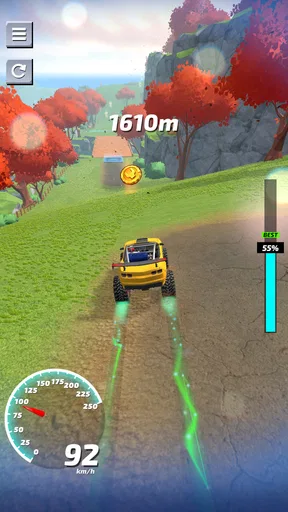
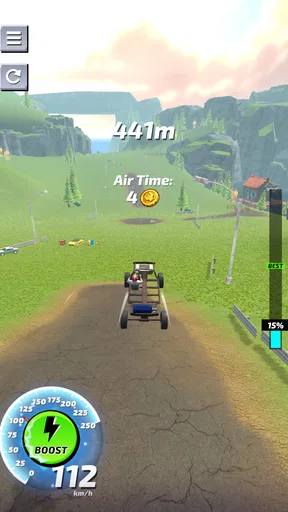
Our Review of Boost Rider: Car Racing Games
 Analysis by Appyee
I spent time with Boost Rider: Car Racing Games to see whether its unusual driving idea could hold my attention beyond a few quick attempts. It is a free racing game from Estoty, built around launching a customized car from a slingshot and then trying to control the result through a chaotic run. That setup gives it a very different rhythm from a conventional lap-based racer: I was thinking less about perfect cornering and more about timing, momentum, upgrades, and how to turn a messy launch into a useful finish.
The game is aimed at Everyone, which makes its basic presentation easy to approach, but the challenge is not necessarily gentle. The appeal comes from short, repeatable attempts where a small adjustment can change the outcome. I found that especially suitable for quick sessions when I wanted something more active than a puzzle but did not want to commit to a long championship or a complicated simulation.
How the slingshot racing idea works in practice
The central concept is simple to understand: prepare your ride, pull back the launch, release it, and manage the car as the course unfolds. That simplicity is useful because I could start playing without studying a long control scheme. The interesting part begins after the launch, when the initial force, the car’s movement, and my reactions all have to work together.
This is not the kind of racing game where success depends only on memorizing a circuit. Each attempt feels more like a compact experiment. I might try a stronger launch, then compensate differently once the car starts moving. When a run fails, the failure usually gives me a practical clue about what to change next time. That loop is the strongest reason to keep playing: the game encourages adjustment rather than demanding a flawless first attempt.
Customizing the car also gives the sessions a sense of direction. I did not view the vehicle as a fixed object that simply gets sent down a track. I treated each modification as part of a plan for the next attempt. If I was struggling to get enough distance, I focused on improving the setup that could help the launch. If the car felt difficult to manage afterward, I became more cautious about chasing raw power at the expense of control.
That trade-off is important. A bigger launch is not automatically a better launch if it leaves the car badly positioned or makes the rest of the run harder to handle. My most useful progress came from changing one thing at a time, watching what happened, and resisting the temptation to spend every available improvement on the most obvious statistic. This makes the game more thoughtful than its playful presentation might suggest.
Why short attempts work well on a phone
Boost Rider fits naturally into small gaps in the day. I could play while waiting for an appointment, take a few attempts during a break, or return to it after putting my phone down without needing to remember a complex story. The launch-and-correct structure gives each try a clear beginning and end, so it does not feel as demanding as a full race that expects uninterrupted attention.
There is also a satisfying “one more attempt” effect. A run that ends just short of a better result makes the next launch feel worthwhile because I already have a specific idea to test. That is more compelling than a generic retry button. The game gives the retry a purpose, even when the change is as small as altering the launch timing or choosing a different vehicle setup.
Still, players who want deep traditional racing may find the format limited. There is less emphasis on wheel-to-wheel competition, racing lines, and long-term lap strategy than in a conventional racer. I would not choose it as a replacement for a serious track game. I see it instead as a physics-focused arcade alternative that uses racing language while building its own kind of challenge.
What customization adds to the experience
The custom-ride element matters because it turns repeated attempts into progression rather than isolated stunts. I had a reason to care about the next run beyond simply beating my previous result. A better setup can make a familiar section feel different, and that gives the game a light planning layer without making it feel like a technical garage simulator.
My advice is to avoid treating customization as a race to maximize one feature. The best choice depends on what is currently stopping the run. If the car launches well but becomes unreliable afterward, adding more force may only make the problem harder to manage. If the car remains controllable but lacks enough movement to reach the next objective, then a more aggressive setup makes more sense. This is one of the game’s less obvious strengths: it rewards diagnosing a failed attempt instead of automatically blaming the car.
I also found it helpful to keep a mental note of which changes produced a real improvement. Because the action is quick, it is easy to make several adjustments and then forget which one mattered. Changing a single element per test makes the progression easier to understand and helps prevent wasted resources or purchases. That approach is especially useful for anyone who wants to enjoy the free experience without feeling pushed to accelerate progress.
Cost, progression, and the value of the free download
The game can be downloaded and played for free, so the initial decision is straightforward: there is no purchase price required to try the core experience. Optional in-app purchases are listed from $1.99 to $59.99 per item. I would therefore judge the game first on how enjoyable its free access feels, rather than assuming that spending is necessary to understand what it offers.
That distinction matters. Free entry gives cautious players a chance to discover whether the slingshot format suits them. Someone who expects a standard racing game can test the controls before committing any money, while a player who enjoys short physics challenges can continue without treating the game like a paid premium title. The purchase range also means that spending decisions should be made carefully, especially if the attraction is mainly the quick retry loop rather than a large content package.
I would not recommend buying anything immediately. My approach was to play enough free attempts to decide whether the launch, driving, and customization loop genuinely held my attention. If I was still enjoying the basic cycle without feeling blocked, there was no urgent reason to pay. If a purchase is considered later, it should solve a clear personal frustration or support a game I already know I will return to, not simply respond to a difficult run.
The value here comes from the interaction between experimentation and replayability. The game does not need a long session to provide a small objective, and its unusual launch mechanic gives each attempt more character than a basic endless drive. For me, that is a better reason to keep it installed than the promise of a large feature list. I can open it, test a setup, learn from a failed launch, and leave after a few minutes with the feeling that I made progress.
At the same time, free access does not automatically make it good value for everyone. Players who measure value by the number of tracks, cars, or competitive modes may prefer a more traditional racer with a broader structure. Boost Rider’s value is narrower and more personal: it is strongest when you enjoy tuning a small decision, watching the physics play out, and trying again with a better idea.
Where the game creates friction
The same physics-driven design that makes the game distinctive can also make it feel unpredictable. A launch that looks promising may develop into a poor run, and players who prefer precise, repeatable controls may interpret that as frustration rather than fun. I became more comfortable once I accepted that not every attempt would be clean, but that mindset will not suit everyone.
There is also a learning curve in understanding what the car is doing after the initial release. The first few attempts can feel more like testing than racing. That is not a flaw by itself, but the game asks for patience before its decisions become readable. If you want immediate speed, clear track boundaries, and familiar steering from the first second, a conventional arcade racer will probably be a better fit.
Another limitation is the possibility of repetition. The compact format encourages retries, but it also means the experience depends heavily on whether the player enjoys refining the same basic type of action. I liked having a focused loop, yet I would not expect it to replace a larger racing game for long sessions. Its best role is as a side game: something I can return to for a handful of attempts rather than a complete racing hobby on its own.
Device compatibility is worth checking before installing. The current version is 1.0.16 and requires at least iOS or Android 12, so older devices and older operating systems are outside the stated requirement. For supported phones, the free download makes testing easy, but anyone using an older handset should confirm compatibility before planning around it.
The game has an average rating of 4.5 from around seventeen thousand ratings, with more than a million installs. Those figures suggest that the unusual format has found a substantial audience, but they should not replace personal testing. A popular racing game can still be the wrong choice if you dislike physics-based retries or want direct competition. I would read the broad reception as encouragement to try it, not as proof that every racing fan will enjoy it.
Who will get the most from it
I think Boost Rider is a good match for players who like arcade experiments, vehicle customization, and short attempts with visible consequences. It is particularly suitable for someone who enjoys asking, “What if I change this one part of the setup?” and then immediately testing the answer. The game also works for casual players who want a racing-themed distraction without learning a large roster of cars or a complicated control system.
It can be useful for families looking for an Everyone-rated game with an accessible premise, although younger players may still need guidance around optional purchases. The safest habit is to treat the free game as the starting point and discuss spending before any purchase is made. That keeps the focus on play rather than turning a difficult attempt into an impulse-buy moment.
I would suggest skipping it if your priority is realistic driving, licensed vehicles, multiplayer rivalry, or a structured season with long races. It is also not the best choice for someone who dislikes trial and error. The slingshot launch is the identity of the game, not a small side activity, so anyone who finds that mechanic irritating will probably not be won over by the customization layer.
For an everyday example, I can imagine opening it on a short commute break, making three attempts, and using each one to test a different launch approach. The first attempt shows where the car loses control, the second changes the setup, and the third checks whether the adjustment helped. That is a realistic use case where the game works well: it gives a compact challenge with enough feedback to make a few minutes feel purposeful.
My recommendation after playing
Estoty has made a racing game that stands apart by making the launch itself the main decision. I enjoyed that it did not ask me to follow the usual lap-and-overtake formula. Instead, it made me think about preparation, timing, momentum, and recovery. The result is playful and approachable, but it still offers enough room for careful players to improve through observation.
My recommendation is to try the free version first and judge it by the quality of that basic loop. If you enjoy experimenting with the car and repeating a run to solve a specific problem, the game offers good personal value without requiring an immediate purchase. If you want a broad, traditional racing package, your money and time will likely be better spent elsewhere, even though the download itself is free.
In the end, Boost Rider: Car Racing Games is best understood as a compact physics challenge wearing a racing-game jacket. Its strongest moments come from turning a failed launch into a useful lesson, while its weakest moments come when the same unpredictability feels like lost control. I would keep it installed for quick sessions and casual experimentation, but I would not present it as a complete substitute for a full-featured racer.
For me, the buy-or-skip decision is clear: download it if the idea of building a ride, launching it with intention, and refining each attempt sounds entertaining. Skip it if you need realism, deep competition, or guaranteed precision. Since access is free and the age rating is Everyone, the sensible route is to test the core experience first, spend only if the game earns that commitment, and let your own tolerance for repetition decide whether it deserves a permanent place on your phone.
Privacy and Permissions
See what permissions an app requests and how it handles your data.
- Wi-Fi connection information
- view Wi-Fi connections
- Other
- view network connections, full network access, control vibration, prevent device from sleeping, Google Play license check
Verdict
Strengths of Boost Rider: Car Racing Games
- Simple controls make it easy for beginners to start racing.
- Short races fit well into quick gaming sessions.
- Bright visuals and energetic effects keep races entertaining.
- Vehicle upgrades add a sense of progression over time.
- Offline play is useful when an internet connection is unavailable.
Limitations of Boost Rider: Car Racing Games
- Repetitive tracks may reduce the challenge after extended play.
- Ads can interrupt the experience, especially between races.
- Some upgrades may require considerable grinding to unlock.
- Touch controls can feel imprecise during fast turns.
- Limited multiplayer options may disappoint competitive racing fans.
Other Releases by Estoty
View All
I Am Cat
Simulation4.5

Frost World - Snow Survival
Role Playing3.9

I Am Security
Role Playing4.6

I Am Monkey
Simulation4.7
Similar Picks in This Category
View All
Hill Climb Racing
Fingersoft4.3

Dr. Driving
SUD Inc.4.2

Traffic Rider
skgames4.5

Asphalt 8 - Car Racing Game
Gameloft SE4.6

Race Master 3D: Car Racing
Beresnev Games4.6

Extreme Car Driving Simulator
AxesInMotion Racing4.3
Frequently Asked Questions
What is Boost Rider: Car Racing Games?
Boost Rider: Car Racing Games is an arcade-style mobile racing game focused on fast-paced driving, quick reactions, and vehicle upgrades. Players race through tracks, avoid obstacles, collect rewards, and use boosts to gain an advantage over rivals. Its accessible controls make it suitable for casual players, while progression and increasingly difficult races provide additional challenges for users who enjoy competitive gameplay.
Is Boost Rider: Car Racing Games free to download and play?
The game can generally be downloaded and played without an upfront purchase, although availability and pricing may vary depending on whether you use Android or iOS. Like many free racing games, it may include optional in-app purchases for coins, upgrades, vehicles, or other bonuses. Before downloading, check the store listing for current purchase details and review your device’s payment settings.
Does the game require an internet connection?
An internet connection may be needed for certain features, such as advertisements, online events, cloud-related services, updates, or leaderboard synchronization. Some basic racing content may remain accessible offline, but this can depend on the version installed and the developer’s current design. If you plan to play while traveling, test the game without Wi-Fi or mobile data after installation.
What controls and gameplay features does Boost Rider offer?
Boost Rider is designed around simple mobile controls that allow players to steer, accelerate, brake, or activate a boost without needing a complicated button layout. The main appeal is quick arcade racing rather than realistic simulation. Depending on the available content, players can also encounter different cars, upgrade systems, track hazards, rewards, missions, and progression-based challenges.
Is Boost Rider: Car Racing Games suitable for children?
The game may be appropriate for children who enjoy racing games, but parents should review its age rating, advertising, privacy information, and in-app purchase options before allowing regular play. Fast gameplay and competitive progression can encourage repeated sessions, while advertisements or optional purchases may appear during use. Parental controls and purchase restrictions are recommended on both Android and iOS devices.
Play our best games!


